Skip to content
Pregnancy, Birth and Baby homeAustralian Government, Department of Health, Disability and Ageing (Opens in new tab)
Pregnancy, Birth and Baby home
Need to talk? Call 1800 882 436.
It's a free call with a maternal child health nurse. *call charges may apply from your mobile.
Is it an emergency? Dial 000
If you need urgent medical help, call triple zero immediately.
  1. Home
  2. Babies
  3. Feeding your baby
  4. How your baby tells you they're hungry

How your baby tells you they're hungry

Download this guide as a PDF

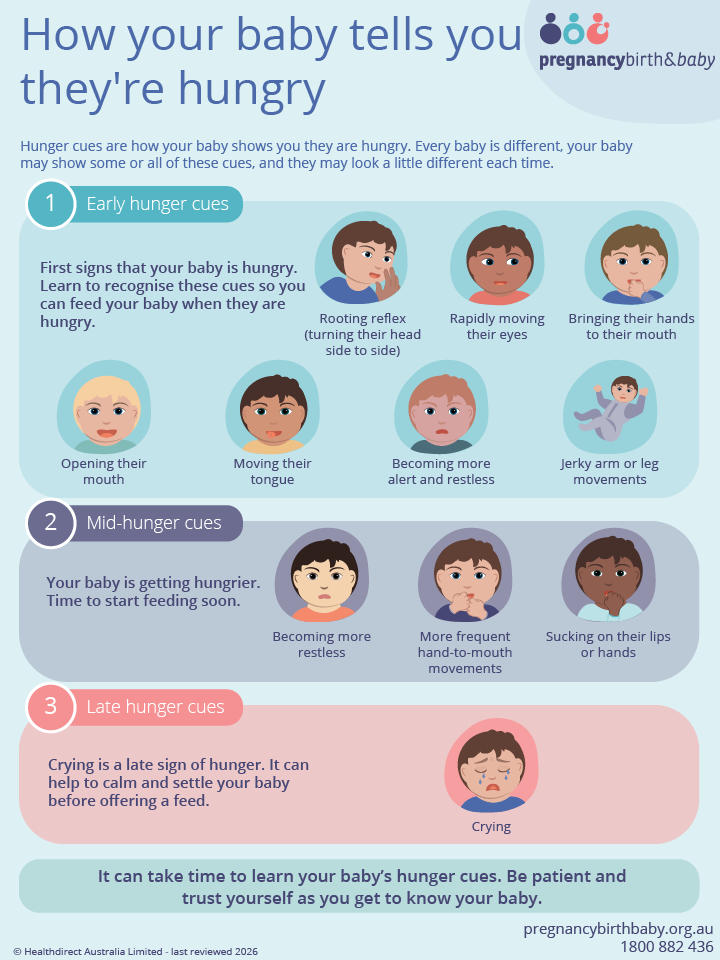
Hunger cues are how your baby shows you they are hungry. Every baby is different, your baby may show some or all of these cues, and they may look a little different each time.

1. Early hunger cues

First signs that your baby is hungry. Learn to recognise these cues so you can feed your baby when they are hungry.

  • rooting reflex (turning their head side to side)
  • rapidly moving their eyes
  • bringing their hands to their mouth
  • opening their mouth
  • moving their tongue
  • becoming more alert and restless
  • jerky arm or leg movements

2. Mid-hunger cues

Your baby is getting hungrier. Time to start feeding soon.

  • becoming more restless
  • more frequent hand-to-mouth movements
  • sucking on their lips or hands

3. Late hunger cues

Crying is a late sign of hunger. It can help to calm and settle your baby before offering a feed.

It can take time to learn your baby's hunger cues. Be patient and trust yourself as you get to know your baby.

Want more like this?

See more guides and infographics from Pregnancy, Birth and Baby.

Find out how we develop and review our content.


Last reviewed: March 2026

Need more information?

These trusted information partners have more on this topic.

Premature babies & sick babies | Raising Children Network

Premature babies and sick babies often need to spend time in the NICU. They need special care and handling, plus a gentle approach to bonding. Find out more.
raisingchildren.net.au (PBB) logo
Learn more on raisingchildren.net.au (PBB) website

Can Babies Be Placed On Their Tummy To Play?

Tummy play is safe and very important for babies from birth. Tummy play helps muscle development in the arms, neck and back. It can help prepare babies for crawling and sitting.
Red Nose logo
Learn more on Red Nose website

My Baby Has Reflux

Reflux is common for up to half of babies under three months of age, and 70% of healthy babies less than 1 year old. Most reflux stops after six months and completely stops within twelve months for 95% of babies.
Red Nose logo
Learn more on Red Nose website

Babies' toys guide | ACCC Product Safety

Babies can suffer a range of injuries from unsafe toys. Make sure you buy sturdy and well-made toys that are appropriate for a baby.
ACCC Product Safety logo
Learn more on ACCC Product Safety website

Bonding with newborns & babies: pictures | Raising Children Network

Bonding with babies is about smiling, cuddling, massage, singing, talking, reading and playing. See how to bond with your baby in our illustrated guide.
raisingchildren.net.au (PBB) logo
Learn more on raisingchildren.net.au (PBB) website

Play ideas for newborn babies | Raising Children Network

Making faces, singing nursery rhymes and blowing raspberries are great play ideas for newborn babies. The key thing is interacting with your baby. Read more.
raisingchildren.net.au (PBB) logo
Learn more on raisingchildren.net.au (PBB) website

Lactose intolerance in babies, children & teens

Lactose intolerance symptoms include wind, stomach pain, bloating and diarrhoea. Babies might also have nappy rash. Your child should see the GP.
raisingchildren.net.au (PBB) logo
Learn more on raisingchildren.net.au (PBB) website

WWWT Worksheets/Strategies: Understanding baby's crying

A baby’s crying is very distressing to parents. It is not known why babies sometimes cry for long periods without being easily comforted. However, babies vary in the amount and intensity of crying in their first year. If babies are well fed and are not currently sick, prolonged crying might be related to being over-stimulated and over-tired. If your baby cries for periods of longer than five to ten minutes and your current soothing strategies do not seem help, perhaps your baby needs quietness and sleep.
What Were We Thinking! logo
Learn more on What Were We Thinking! website

How to wrap a baby | Raising Children Network

See how to wrap a baby in this video. Wrapping can reduce SUDI and SIDS risk by keeping babies on their backs during sleep. It can also soothe babies.
raisingchildren.net.au (PBB) logo
Learn more on raisingchildren.net.au (PBB) website

Why Do Babies Cry? | Karitane Tips for Soothing & Settling

Learn why babies cry and how to soothe them with Karitane's expert advice. Understand hunger cues, sleep patterns, and settling techniques.
Karitane logo
Learn more on Karitane website

Related pages

  • Babies in hot weather
  • Being at home with your baby after giving birth
  • Cleaning and sterilising baby bottles
  • Common myths about babies
  • Getting out of the house with your new baby

Search our site for

  • Breastfeeding
  • Childbirth
  • Newborn Infants
  • Baby Clothes
  • Bottle Feeding

Find a health service

Search now

Need further advice or guidance from our maternal child health nurses?
1800 882 436 Video call
Logo for Pregnancy, Birth and Baby

Pregnancy, Birth and Baby is funded by the Australian Government and operated by Healthdirect Australia.

About

About Pregnancy, Birth and BabyAbout our contentInformation partnersOur privacy commitmentTerms of useHow we use AIPromotional material

Explore

A to Z topicsDue date calculatorFind local health servicesGlossary of pregnancy and labourPregnancy and parenting in picturesPregnancy and baby appsSymptom Checker (Opens in new tab)

Connect

Contact usVideo callNewslettersLinking to us (Opens in new tab)Consumer engagement (Opens in new tab)

Follow

Australian Government, Department of Health, Disability and AgeingLogo for healthdirect Australia

Pregnancy, Birth and Baby’s information and advice are developed and managed within a rigorous clinical governance framework (Opens in new tab).

This site is protected by reCAPTCHA and the Google Privay Policy (Opens in new tab) and Terms of Service (Opens in new tab) apply.

Healthdirect Australia acknowledges the Traditional Owners of Country throughout Australia and their continuing connection to land, sea and community. We pay our respects to the Traditional Owners and to Elders both past and present.

© 2026 Healthdirect Australia Limited

This information is for your general information and use only and is not intended to be used as medical advice and should not be used to diagnose, treat, cure or prevent any medical condition, nor should it be used for therapeutic purposes.
The information is not a substitute for independent professional advice and should not be used as an alternative to professional health care. If you have a particular medical problem, please consult a healthcare professional.
Except as permitted under the Copyright Act 1968, this publication or any part of it may not be reproduced, altered, adapted, stored and/or distributed in any form or by any means without the prior written permission of Healthdirect Australia.