Skip to content
logo_australian-government-department-of-health-disability-and-ageing.svg
Need to talk? Call 1800 882 436.
It's a free call with a maternal child health nurse. *call charges may apply from your mobile.
Is it an emergency? Dial 000
If you need urgent medical help, call triple zero immediately.
  1. Home/
  2. Babies/
  3. Your baby's health and wellbeing/
  4. Umbilical hernia in babies

Search our site for

  • Hernias
  • Umbilical Cord

Find a health service

Search now

Umbilical hernia in babies

Key facts

  • An umbilical hernia is a soft lump under the skin at or around your baby's belly button (umbilicus).
  • Umbilical hernias are common in babies and small children.
  • They often get better on their own, by the age of 5 years.
  • Sometimes, surgery is needed to repair an umbilical hernia.
  • See your doctor immediately if your baby's umbilical hernia becomes painful.
  • On this page

    • What is an umbilical hernia?
    • What are the symptoms of an umbilical hernia?
    • What causes an umbilical hernia?
    • When should I see my doctor?
    • How is an umbilical hernia diagnosed?
    • How is an umbilical hernia treated?
    • What are the complications of an umbilical hernia?
    • Can an umbilical hernia be prevented?
    • Resources and support

    What is an umbilical hernia?

    An umbilical hernia is a soft lump under the skin at or around your baby's belly button (umbilicus). Umbilical hernias are common in babies.

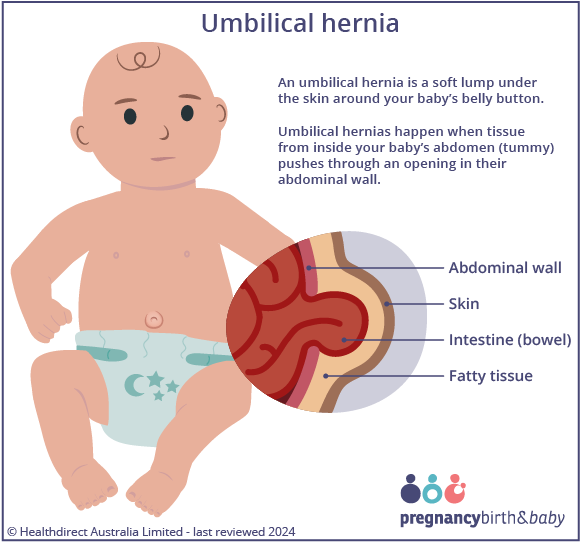
    Umbilical hernias happen when tissue from inside your baby's abdomen (tummy) pushes through an opening in their abdominal wall. You can usually push the lump back in.

    Umbilical hernias in babies and children often get better on their own, around the age of 4 or 5 years. Surgery is sometimes needed to repair the hernia.

    Illustration of an umbilical hernia.

    Illustration of an umbilical hernia.

    What are the symptoms of an umbilical hernia?

    An umbilical hernia is a soft lump or bulge under the skin. Most umbilical hernias in babies are noticed shortly after birth, when the umbilical cord stump drops off. They rarely cause symptoms.

    An umbilical hernia may be more noticeable when your baby:

    • cries
    • strains
    • coughs

    Your baby's umbilical hernia may get bigger over the first few months of their life. Most umbilical hernias do not cause pain. Some older children may have mild discomfort.

    CHECK YOUR SYMPTOMS — Use the Symptom Checker and find out if you need to seek medical help.

    What causes an umbilical hernia?

    The area where your baby's umbilical cord was attached turns into their belly button. There is a ring of muscle around the belly button that closes after birth. Umbilical hernias happen when it takes longer than usual for this ring to close.

    Umbilical hernias are more common in babies who are born with a low birth weight or born prematurely. They are also more common in babies with certain health conditions, such as Down syndrome.

    When should I see my doctor?

    Babies and children with an umbilical hernia should be checked by a doctor, as there can be complications.

    Seek urgent medical attention if your baby or child has:

    • severe pain around the hernia
    • a hernia that you can't push back in or that feels firm
    • pain when you press on the hernia
    • red or purple skin around the hernia
    • vomiting
    • abdominal pain
    • constipation

    FIND A HEALTH SERVICE — The Service Finder can help you find doctors, pharmacies, hospitals and other health services.

    How is an umbilical hernia diagnosed?

    Your doctor will ask what you have noticed and examine your baby.

    An umbilical hernia can be diagnosed by examining your baby. No tests are needed.

    How is an umbilical hernia treated?

    Most umbilical hernias close by the age of 5 years without any treatment.

    Surgery may be needed if:

    • the hernia hasn't closed by the age of 4 to 5 years
    • your child's umbilical hernia is large
    • your child has symptoms, such as pain
    • the hernia is growing
    • there are complications

    Surgery

    A hernia repair operation can be done under general anaesthetic. The procedure can usually be done as day surgery.

    Your child may need to rest for a day or 2 after an umbilical hernia repair. Your doctor may recommend pain-relief medicines for your child as needed.

    Rare complications of hernia repair operations are bleeding and infection. Sometimes the hernia can come back after surgery. This is more likely if the wound was infected, but it is still uncommon. Your surgeon will discuss these risks with you before the surgery.

    Your child will likely have a follow-up appointment with the surgeon after a few weeks.

    What are the complications of an umbilical hernia?

    Rarely, a part of your child's bowel, other abdominal organs or tissue can become trapped inside an umbilical hernia. This is called an 'incarcerated hernia'. It causes pain and discomfort. If this happens, you may not be able to push the hernia back in.

    If the blood supply to the bowel inside the hernia is cut off, this is called a 'strangulated hernia'.

    If part of the bowel inside the hernia gets blocked, your child can get a bowel obstruction. This causes vomiting, constipation and abdominal (tummy) pain in babies.

    Your doctor will tell you what to look for just in case these rare complications happen.

    Emergency medical treatment is needed in these rare situations.

    Can an umbilical hernia be prevented?

    There is no known way to prevent an umbilical hernia from developing.

    Resources and support

    See your doctor or child health nurse if you are concerned your baby may have an umbilical hernia.

    The Sydney Children's Hospitals Network has information on umbilical hernias.

    Healthdirect has information on umbilical hernia repair.

    Speak to a maternal child health nurse

    Call Pregnancy, Birth and Baby to speak to a maternal child health nurse on 1800 882 436 or video call. Available 7am to midnight (AET), 7 days a week.

    • BMJ Best Practice — Umbilical hernia in children
    • The Royal Children\u2019s Hospital Melbourne — Umbilical hernia
    • Safer Care Victoria — Umbilical hernia in neonates
    • Children’s Health Queensland Hospital and Health Service — Common umbilical disorders – Emergency management in infants
    • The Sydney Children's Hospitals Network — Umbilical hernia
    • JMIR Publications — Multiple Automated Health Literacy Assessments of Written Health Information: Development of the SHeLL (Sydney Health Literacy Lab) Health Literacy Editor v1

    Find out how we develop and review our content.


    Last reviewed: November 2024


    Need further advice or guidance from our maternal child health nurses?
    1800 882 436
    Video call
    logo-pbb.svg

    Pregnancy, Birth and Baby is funded by the Australian Government and operated by Healthdirect Australia.

    About
    About Pregnancy, Birth and BabyAbout our contentInformation partnersOur privacy commitmentTerms of useHow we use AIPromotional material
    Explore
    A to Z topicsDue date calculatorFind local health servicesGlossary of pregnancy and labourPregnancy and parenting in picturesPregnancy and baby appsSymptom Checker
    Connect
    Contact usVideo callNewslettersLink to usConsumer engagement

    Follow

    logo_dep-health_white.svglogo-hda-white.svg

    Pregnancy, Birth and Baby’s information and advice are developed and managed within a rigorous clinical governance framework.

    This site is protected by reCAPTCHA and the Google Privacy Policy and Terms of Service apply.

    Healthdirect Australia acknowledges the Traditional Owners of Country throughout Australia and their continuing connection to land, sea and community. We pay our respects to the Traditional Owners and to Elders both past and present.

    © 2026 Healthdirect Australia Limited

    This information is for your general information and use only and is not intended to be used as medical advice and should not be used to diagnose, treat, cure or prevent any medical condition, nor should it be used for therapeutic purposes.
    The information is not a substitute for independent professional advice and should not be used as an alternative to professional health care. If you have a particular medical problem, please consult a healthcare professional.
    Except as permitted under the Copyright Act 1968, this publication or any part of it may not be reproduced, altered, adapted, stored and/or distributed in any form or by any means without the prior written permission of Healthdirect Australia.