Speak to a maternal child health nurse
Call Pregnancy, Birth and Baby to speak to a maternal child health nurse on 1800 882 436 (Opens in new tab) or video call. Available 7am to midnight (AET), 7 days a week.

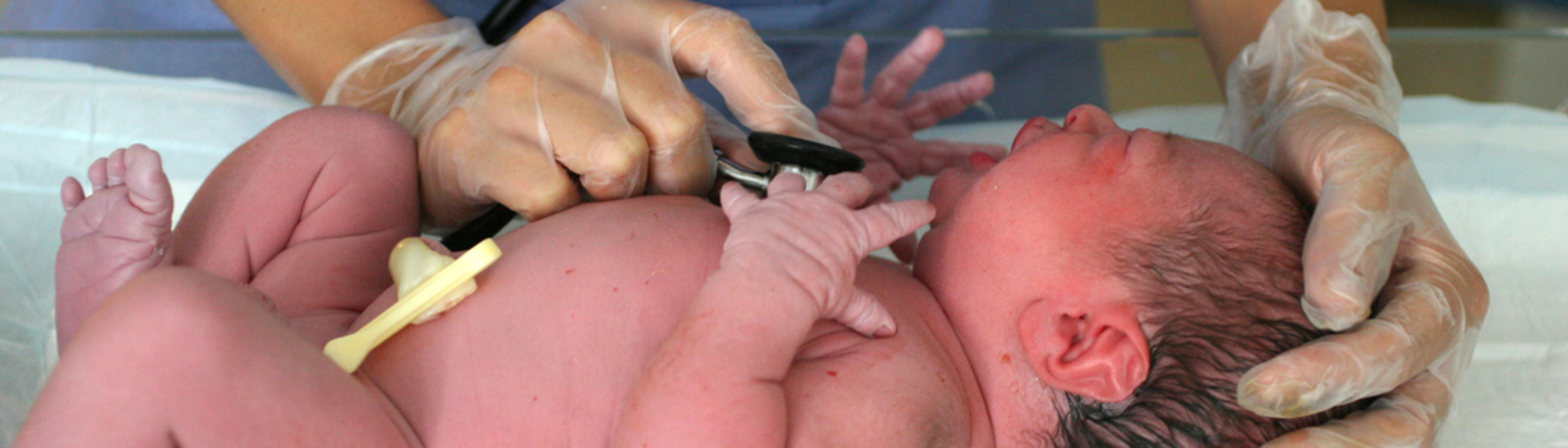
The Apgar score is a test used by doctors and midwives to check your baby's health when they are born. It helps them understand if your baby needs any extra care at birth.
The Apgar score is used to check a newborn baby at 1 minute, 5 minutes and, if needed, 10 minutes after birth.
The test is named after Dr Virginia Apgar, who developed the score in 1952.
The Apgar score rates your baby's:
Each sign is scored from 0 to 2, with 2 being the best score. The scores for each sign are added together to give a total possible Apgar score out of 10.
| Sign | 0 | 1 | 2 |
|---|---|---|---|
| Skin colour | Blue or pale body | Blue hands and feet | Completely pink skin |
| Heart rate | Absent | <100 beats per minute | >100 beats per minute |
| Reflexes and responsiveness | No response | Grimace (expressive) | Cry or active withdrawal |
| Muscle tone | Completely limp | Some flexion (stiffness) | Active motion |
| Breathing | Absent | Irregular or shallow breathing, weak cry | Good breathing effort, crying |
Blue hands and feet are normal for a newborn in their first hours of life. This is why the highest Apgar score is usually 9 out of 10.
An Apgar score of 7 or more at 5 minutes after birth shows that your baby is coping well after birth. If a baby scores below 7 at 5 minutes after birth, this is considered a low Apgar score.
If your baby's Apgar score is low at 5 minutes, your baby will most likely need help with breathing and the doctors will continue to closely monitor your baby.
If your baby has a low Apgar score, they will need extra medical help.
Babies with an Apgar score below 7 at 5 minutes of life are more likely to need extra support with breathing or admission to the special care nursery or neonatal intensive care unit.
There are many factors that can affect an Apgar score. These include:
The Apgar score reflects your baby's condition at birth and helps guide their immediate care.
Apgar scores are intended to check the immediate health of newborn babies. They are used to monitor babies and to make sure they get all the care they need straight after birth to help them adjust to life outside the womb.
Apgar scores are not intended to predict how a baby’s nervous system and brain will develop.
If you have any concerns, speak with your doctor, midwife or nurse.
The Royal Women’s Hospital in Melbourne has information on what happens after you give birth (Opens in new tab), including the Apgar score.
NSW Health (Opens in new tab) has helpful information on how Apgar scores are used by your health team, including why it’s collected and what it measures.
Visit Birthing on Country (Opens in new tab) for information on projects that support Aboriginal and/or Torres Strait Islander babies and their families.
Find an Aboriginal Community Controlled Health Organisation (ACCHO) (Opens in new tab) or affiliate near you.
Baby Coming You Ready (Opens in new tab) is a culturally safe support for Aboriginal and Torres Strait Islander parents-to-be and new parents.
The Koori Maternity Service (Opens in new tab) program provides access to holistic, culturally safe maternity care for Aboriginal and/or Torres Strait Islander peoples.
Stronger Bubba Born (Opens in new tab) has resources for Aboriginal and/or Torres Strait Islander parents.
The Multicultural Centre for Women’s Health (Opens in new tab) has a catalogue of culturally adapted health resources available in more than 70 languages.
Monash Health (Opens in new tab) has a range of translated resources including information on pregnancy and baby safety in many community languages.

Call Pregnancy, Birth and Baby to speak to a maternal child health nurse on 1800 882 436 (Opens in new tab) or video call. Available 7am to midnight (AET), 7 days a week.
Find out how we develop and review our content.
Last reviewed: February 2026