Speak to a maternal child health nurse
Call Pregnancy, Birth and Baby to speak to a maternal child health nurse on 1800 882 436 (Opens in new tab) or video call. Available 7am to midnight (AET), 7 days a week.

An umbilical hernia is a soft lump under the skin at or around your baby's belly button (umbilicus). Umbilical hernias are common in babies.
Umbilical hernias happen when tissue from inside your baby's abdomen (tummy) pushes through an opening in their abdominal wall. You can usually push the lump back in.
Umbilical hernias in babies and children often get better on their own, around the age of 4 or 5 years. Surgery is sometimes needed to repair the hernia.
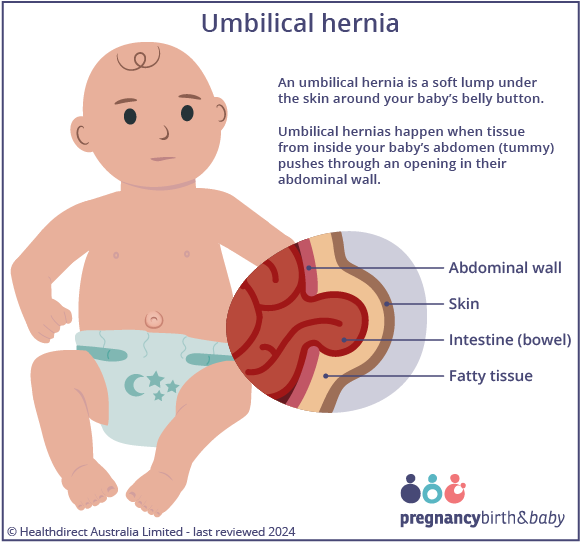
Illustration of an umbilical hernia.
An umbilical hernia is a soft lump or bulge under the skin. Most umbilical hernias in babies are noticed shortly after birth, when the umbilical cord stump drops off. They rarely cause symptoms.
An umbilical hernia may be more noticeable when your baby:
Your baby's umbilical hernia may get bigger over the first few months of their life. Most umbilical hernias do not cause pain. Some older children may have mild discomfort.
The area where your baby's umbilical cord was attached turns into their belly button. There is a ring of muscle around the belly button that closes after birth. Umbilical hernias happen when it takes longer than usual for this ring to close.
Umbilical hernias are more common in babies who are born with a low birth weight or born prematurely. They are also more common in babies with certain health conditions, such as Down syndrome.
Babies and children with an umbilical hernia should be checked by a doctor, as there can be complications.
Seek urgent medical attention if your baby or child has:
Your doctor will ask what you have noticed and examine your baby.
An umbilical hernia can be diagnosed by examining your baby. No tests are needed.
Most umbilical hernias close by the age of 5 years without any treatment.
Surgery may be needed if:
A hernia repair operation (Opens in new tab) can be done under general anaesthetic (Opens in new tab). The procedure can usually be done as day surgery.
Your child may need to rest for a day or 2 after an umbilical hernia repair. Your doctor may recommend pain-relief medicines for your child as needed.
Rare complications of hernia repair operations are bleeding and infection. Sometimes the hernia can come back after surgery. This is more likely if the wound was infected, but it is still uncommon. Your surgeon will discuss these risks with you before the surgery.
Your child will likely have a follow-up appointment with the surgeon after a few weeks.
Rarely, a part of your child's bowel, other abdominal organs or tissue can become trapped inside an umbilical hernia. This is called an 'incarcerated hernia'. It causes pain and discomfort. If this happens, you may not be able to push the hernia back in.
If the blood supply to the bowel inside the hernia is cut off, this is called a 'strangulated hernia'.
If part of the bowel inside the hernia gets blocked, your child can get a bowel obstruction (Opens in new tab). This causes vomiting, constipation and abdominal (tummy) pain in babies.
Your doctor will tell you what to look for just in case these rare complications happen.
Emergency medical treatment is needed in these rare situations.
There is no known way to prevent an umbilical hernia from developing.
See your doctor or child health nurse if you are concerned your baby may have an umbilical hernia.
The Sydney Children's Hospitals Network has information on umbilical hernias (Opens in new tab).
Healthdirect has information on umbilical hernia repair (Opens in new tab).

Call Pregnancy, Birth and Baby to speak to a maternal child health nurse on 1800 882 436 (Opens in new tab) or video call. Available 7am to midnight (AET), 7 days a week.
Find out how we develop and review our content.
Last reviewed: November 2024