


Skip to content
logo_australian-government-department-of-health-disability-and-ageing.svg
Need to talk? Call 1800 882 436.
It's a free call with a maternal child health nurse. *call charges may apply from your mobile.
Is it an emergency? Dial 000
If you need urgent medical help, call triple zero immediately.
  1. Home/
  2. Babies/
  3. Looking after your newborn/
  4. Baby poo colour chart
Find a health service

Search now

Baby poo colour chart

Download this guide as a PDF

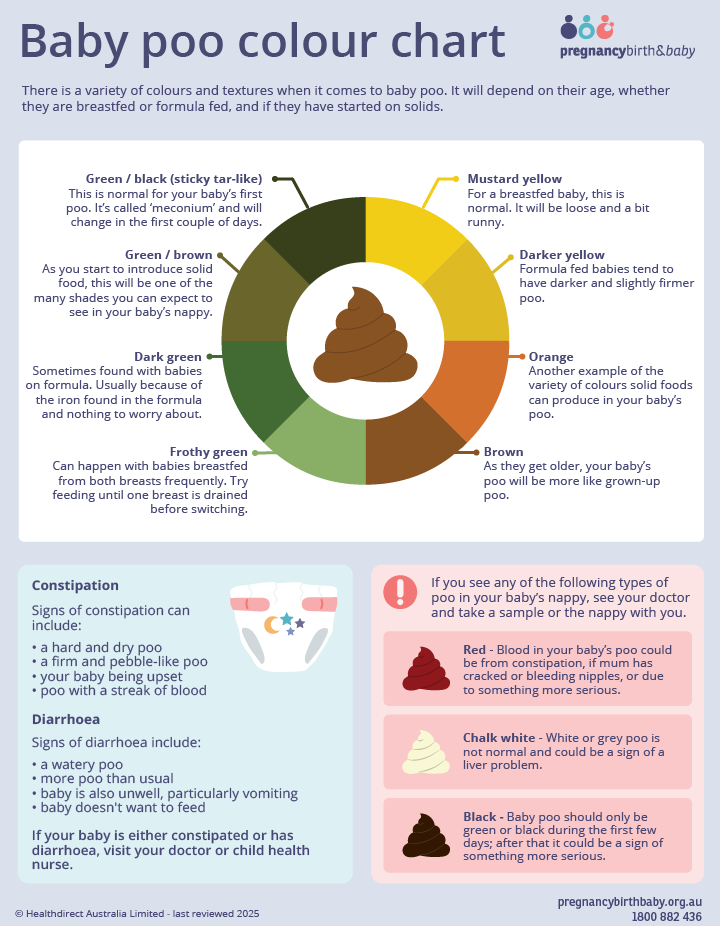
There is a variety of colours and textures when it comes to baby poo. It will depend on their age, whether they are breastfed or formula fed, and if they have started on solids.

What is normal?

Green / black (sticky tar-like)

This is normal for your baby's first poo. It's called 'meconium' and will change in the first couple of days.

Mustard yellow

For a breastfed baby, this is normal. It will be loose and a bit runny.

Darker yellow

Formula fed babies tend to have darker and slightly firmer poo.

Frothy green

Can happen with babies breastfed from both breasts frequently. Try feeding until one breast is drained before switching.

Dark green

Sometimes found with babies on formula. Usually because of the iron found in the formula and nothing to worry about.

Green / brown

As you start to introduce solid food, this will be one of the many shades you can expect to see in your baby's nappy.

Orange

Another example of the variety of colours solid foods can produce in your baby's poo.

Brown

As they get older, your baby's poo will be more like grown-up poo.

What is not normal?

If you see any of the following types of poo in your baby's nappy, see your doctor and take a sample or the nappy with you.

Red

Blood in your baby's poo could be from constipation, if mum has cracked/bleeding nipples, or due to something more serious.

Chalk white

White or grey poo is not normal and could be a sign of a liver problem.

Black

Baby poo should only be green or black during the first few days; after that it could be a sign of something more serious.

Constipation versus diarrhoea

Constipation

Signs of constipation can include:

  • a hard and dry poo
  • a firm and pebble-like poo
  • your baby being upset
  • poo with a streak of blood

Diarrhoea

Signs of diarrhoea include:

  • a watery poo
  • more poo than usual
  • baby is also unwell, particularly vomiting
  • baby doesn't want to feed

If your baby is either constipated or has diarrhoea, visit your doctor or child health nurse.

Want more like this?

See more guides and infographics from Pregnancy, Birth and Baby.

Find out how we develop and review our content.


Last reviewed: February 2025


Need further advice or guidance from our maternal child health nurses?
1800 882 436
Video call
logo-pbb.svg

Pregnancy, Birth and Baby is funded by the Australian Government and operated by Healthdirect Australia.

About
About Pregnancy, Birth and BabyAbout our contentInformation partnersOur privacy commitmentTerms of useHow we use AIPromotional material
Explore
A to Z topicsDue date calculatorFind local health servicesGlossary of pregnancy and labourPregnancy and parenting in picturesPregnancy and baby appsSymptom Checker
Connect
Contact usVideo callNewslettersLink to usConsumer engagement

Follow

logo_dep-health_white.svglogo-hda-white.svg

Pregnancy, Birth and Baby’s information and advice are developed and managed within a rigorous clinical governance framework.

This site is protected by reCAPTCHA and the Google Privacy Policy and Terms of Service apply.

Healthdirect Australia acknowledges the Traditional Owners of Country throughout Australia and their continuing connection to land, sea and community. We pay our respects to the Traditional Owners and to Elders both past and present.

© 2026 Healthdirect Australia Limited

This information is for your general information and use only and is not intended to be used as medical advice and should not be used to diagnose, treat, cure or prevent any medical condition, nor should it be used for therapeutic purposes.
The information is not a substitute for independent professional advice and should not be used as an alternative to professional health care. If you have a particular medical problem, please consult a healthcare professional.
Except as permitted under the Copyright Act 1968, this publication or any part of it may not be reproduced, altered, adapted, stored and/or distributed in any form or by any means without the prior written permission of Healthdirect Australia.